



Texas home sellers typically pay brokerage compensation, title insurance, escrow and recording fees, prorated property taxes and HOA dues, their mortgage payoff, and any concessions negotiated with the buyer. Texas charges no real estate transfer tax, which removes a line item sellers in most other states can't avoid. Total costs vary by transaction, but the single most useful thing a seller can do is request an itemized seller net sheet before listing.
Selling a home often feels like a math problem where the answer hides until the very last page. You know your sale price. You know roughly what you owe. But the number that actually lands in your bank account after closing depends on a list of costs most sellers don't think about until they're staring at a settlement statement, wondering where a chunk of their equity went.
None of it is a mystery once you know what to look for. This guide walks through the major expenses a Montgomery County seller may need to budget for, roughly in the order it shows up, from the moment you decide to list to the moment you hand over the keys.
First, a note on the market you're selling in
Context matters, because several of these costs move with market conditions.
Right now, the Greater Houston area, including Montgomery County, is carrying the most inventory it has seen in years. Active listings across the region recently reached the highest level the Houston Association of REALTORS® has ever recorded, and conditions have become more buyer-favorable than the seller's market many Montgomery County homeowners remember from a few years ago. Sales are still happening at a steady clip and prices have held roughly flat, so this is not a collapse. It's a market where buyers have choices.
What that means practically for your costs: concessions and pre-listing repairs are doing more work than they were two or three years ago, and homes that are priced and presented well still move while overpriced ones sit and eventually sell for less after reductions. Budget accordingly.

1. Real Estate Brokerage Compensation
Brokerage compensation is usually the largest single line on a seller's closing statement.
Compensation is fully negotiable and is not set by law. What you pay depends entirely on the listing agreement you sign with your brokerage and on the terms of the specific transaction. Depending on what's negotiated, a seller may pay compensation to their listing brokerage and may also agree to contribute toward compensation for the buyer's brokerage.
Since the industry-wide changes to how compensation is handled, buyer's agent compensation is negotiated deal by deal rather than advertised in advance. That makes the up-front conversation with your agent more important, not less. Ask two questions before you sign anything:
- What exactly am I agreeing to pay, and to whom?
- What does it cover?
The second question matters as much as the first. A full-service brokerage handling professional photography, pricing strategy, staging guidance, marketing, showing coordination, and negotiation is a different product from a discount model that leaves those pieces to you. In a market with this much inventory, the pieces that make your listing stand out are not a luxury.
Note: Real estate brokerage compensation is fully negotiable and is not set by law.
2. Repairs and Pre-Listing Improvements
Before a home ever hits the market, most sellers spend something getting it show-ready. This ranges from a few hundred dollars in touch-up paint and deep cleaning to tens of thousands in repairs, especially if you skip the prep and an inspection contingency forces the issue later anyway.
Common pre-listing costs in Montgomery County:
- Cosmetic fixes — paint, carpet cleaning or replacement, landscaping cleanup. Curb appeal does disproportionate work in neighborhoods where several similar homes are listed at once.
- Deferred maintenance — leaky faucets, cracked tile, HVAC service. Given how hard Southeast Texas summers are on air conditioning systems, a documented recent HVAC service is a genuine selling point here.
- Staging — full professional staging or simply renting a few key pieces for photos.
- Pre-listing inspection — optional, increasingly common, and often the single best money a seller spends.
A pre-listing inspection typically runs a few hundred dollars and lets you fix problems on your own timeline rather than under pressure during the option period. Fixing a known issue on your schedule is almost always cheaper than fixing it while a buyer's leverage clock is running.
Texas buyers also commonly ask about foundation and drainage, given our clay soils. If there's history there, having documentation and a professional opinion ready before you list prevents a small question from becoming a renegotiation.
3. Seller Concessions
When buyers have options, sellers compete. Concessions are how that competition shows up on a settlement statement.
A concession might be a contribution toward the buyer's closing costs, a rate buydown to lower their monthly payment, or a home warranty. Rate buydowns have become a particularly common tool while mortgage rates sit in the mid- to upper-6% range, because a buydown often moves a buyer's monthly payment more than an equivalent price reduction would.
Concessions are negotiated as part of the purchase contract, and the amount varies widely by property and situation. They aren't automatic, they're a negotiating tool. The smart move is to decide your ceiling before offers arrive, rather than deciding in the moment under time pressure.
4. Title Insurance and Closing Fees
In Texas, sellers customarily pay the title insurance policy, which protects the buyer against future claims on the property's title.
Two things make Texas different from most states here:
Title rates are promulgated by the state. The Texas Department of Insurance sets basic premium rates, so the price of the policy is the same regardless of which title company closes your transaction. You can't shop for a cheaper premium, but you also can't be overcharged.
Texas closings are handled by title companies, not attorneys. Texas doesn't require a real estate attorney to close a sale. Most straightforward residential transactions never involve one. If your situation is complicated — a divorce, an estate sale, a partnership dispute, a 1031 exchange — an attorney review is worth budgeting for, but it's the exception rather than the rule.
Beyond the title policy, expect a handful of smaller closing-related fees:
- Escrow or closing fees, often split between buyer and seller
- Recording fees for releasing the old deed or mortgage
- Notary and courier or wire fees
- HOA transfer and resale certificate fees, which are common across Montgomery County's many master-planned and deed-restricted communities. Who pays is negotiable, and in a buyer-favorable market sellers absorb these more often.
None of these individually break the bank, but together they add up to a few hundred to a couple thousand dollars.
5. Transfer Taxes — Good News for Texas Sellers
Many states, counties, and cities charge a transfer tax (sometimes called a conveyance tax or documentary stamp tax) when property changes hands. Rates elsewhere range from a small flat fee to well over 1% of the sale price.
Texas does not charge a real estate transfer tax. Not at the state level, and not in Montgomery County.
If you're relocating from California, New York, Florida, or Pennsylvania, this is a line item you're used to seeing that simply won't appear on your Texas settlement statement.
6. Prorated Property Taxes and HOA Dues
This one trips up sellers who've only ever bought and sold in other states, because Texas property taxes are paid in arrears.
Your tax bill for the current year arrives in the fall and isn't due until the end of January. If you close mid-year, you've incurred months of tax obligation you haven't paid yet. At closing, you credit the buyer for your prorated share, and they pay the full bill when it arrives.
On your settlement statement, this shows up as a seller debit and a buyer credit. It isn't really a new cost, it's an adjustment for an obligation you already owed. But because Montgomery County property tax rates are meaningful, the number can be larger than out-of-state sellers expect.
Two Montgomery County-specific wrinkles:
- MUD districts. Many area communities sit inside Municipal Utility Districts with their own tax rate on top of county, city, school, and college district levels. Your total effective rate, and therefore your proration, depends on which taxing jurisdictions your property falls in.
- Homestead and over-65 exemptions. If you carry an exemption, it affects the assessed value your proration is calculated against. Bring this up with your title company early.
HOA dues prorate the same way, based on your closing date and your community's billing cycle.
7. Mortgage Payoff Costs
If you still have a mortgage, the payoff amount at closing usually includes more than your remaining principal balance. Expect:
- Prorated interest through the closing date
- A recording or release fee to clear the lien
- Prepayment penalties, in the rare cases where your loan includes one (more common with certain investment property loans)
Request a payoff statement from your lender a few weeks before closing so the exact number isn't a surprise. And if you have a home equity loan, HELCO, solar panel financing, or a contractor's lien on the property, those have to be cleared too — solar financing in particular has caught a lot of Texas sellers off guard in the last few years.
8. Capital Gains Tax
This is the cost that catches sellers most off guard, because it isn't handled at the closing table. It shows up later, at tax time.
The IRS offers a substantial exclusion: single filers can typically exclude up to $250,000 of gain, and married couples filing jointly up to $500,000, provided the home was your primary residence for at least two of the last five years. Many sellers fall entirely within this exclusion and owe nothing.
If your gain exceeds it, increasingly common for owners who bought in Montgomery County a decade or more ago and have watched the area's growth, the excess is generally taxed as capital gains.
Keep records of capital improvements over the years you owned the home: a new roof, an addition, a major renovation. These typically increase your cost basis, which reduces your taxable gain. That's a conversation worth having with a tax professional before you sell, not after. Real estate professionals do not provide tax advice.
9. Moving Costs
Easy to treat as an afterthought, but it's real money. Depending on distance and volume, budget anywhere from a few hundred dollar for a local DIY move to several thousands for a long-distance move with professional movers.
Costs that often ride along:
- Temporary storage if there's a gap between closing and your next move-in date
- Final cleaning for the home you're leaving
- Utility transfers and final bills
10. Overlap Costs If You're Buying Another Home
If you're selling and buying at the same time, there's a real possibility of a stretch where you're carrying two properties, even briefly. That might mean overlapping mortgages payments, double insurance premiums, or a short-term bridge loan.
This risk is higher right now than it was a few years ago. With more inventory on the market, homes are taking longer to sell than they did at the peak, which makes a clean simultaneous close harder to time. Build a buffer into your budget even if you're planning on everything lining up.
Putting It All Together: A Simplified Illustration
Here's a rough illustration for a home selling at $400,000 with a $150,000 mortgage balance. These are placeholder figures for structure only — your actual numbers depend on your contract terms, your negotiated compensation, and your specific property.
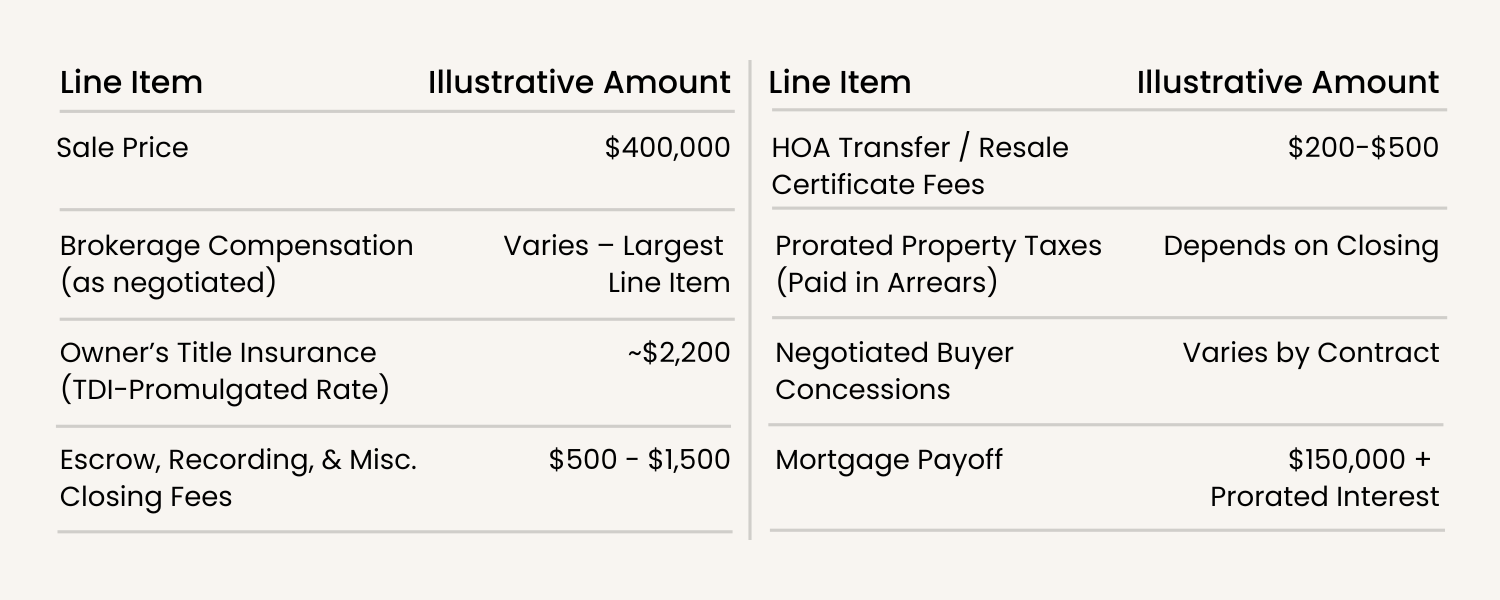
That's before capital gains tax, if applicable, and before moving costs. On paper, a $400,000 sale price shrinks to meaningfully less in actual proceeds, which is exactly why going in with clear expectations matters.
What Sellers Should Actually Take Away
Selling a home is rarely as simple as "sale price minus mortgage balance equals profit." Compensation, repairs, concessions, prorations, and title fees all take a bite before you see a final number.
But none of these costs should be a surprise. Every one of them is predictable and can be estimated well in advance with the help of a good agent, a title company, and for the tax pieces, a qualified accountant.
The sellers who walk away from closing feeling good about the outcome aren't the ones who had the fewest costs. They're the ones who knew exactly what to expect from day one.
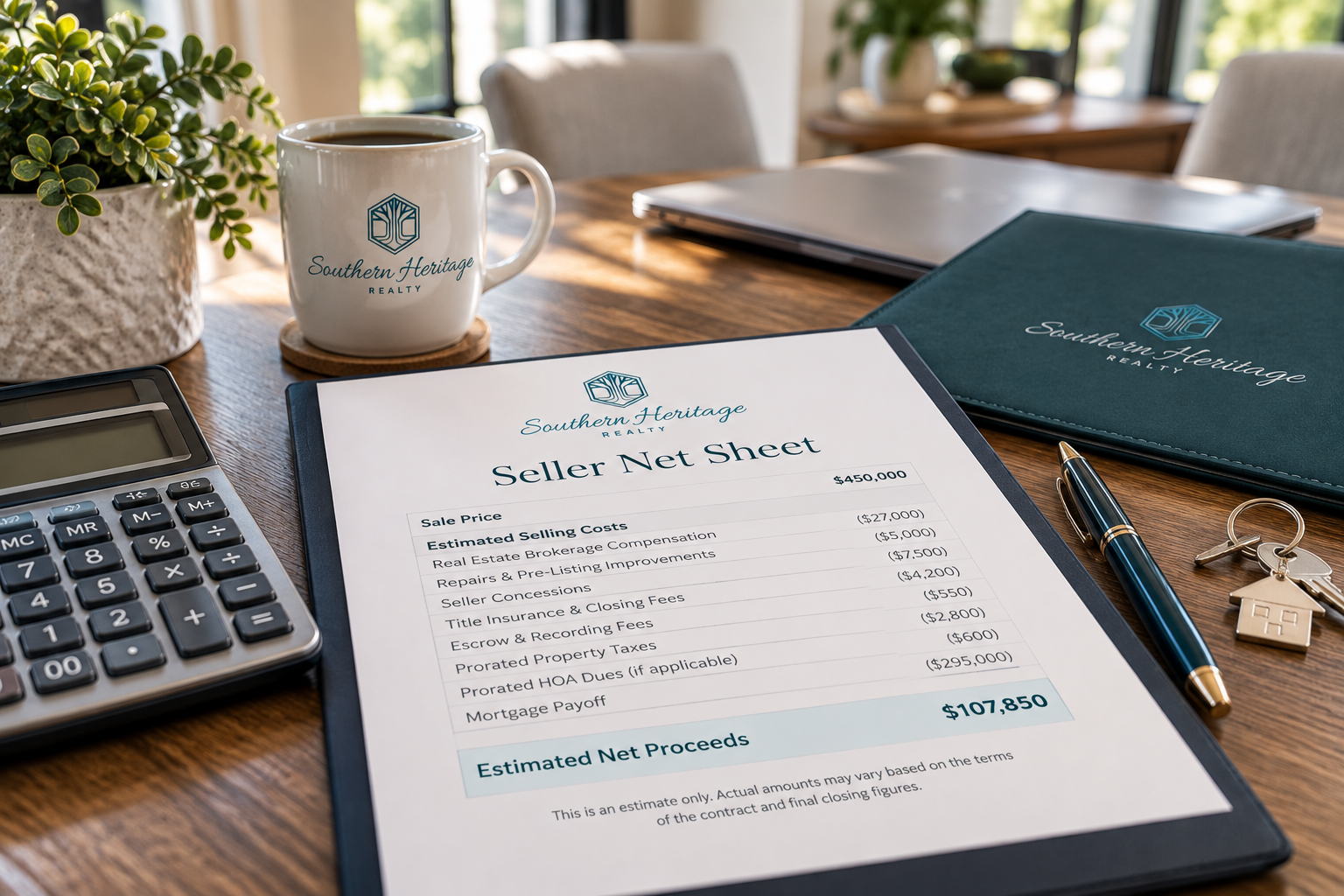
Ask for a seller net sheet before you put a sign in the yard. An itemized estimate of all these costs measured against your expected sale price is the single most useful document you can have in hand, and it should be updated once you have a real offer on the table.
Talk to Southern Heritage Realty
Southern Heritage Realty works with sellers throughout Montgomery County and across Southeast Texas, from Huntsville down to Galveston. We'll prepare a detailed seller net sheet for your property at no cost and walk you through every line on it — before you commit to anything.
If you're thinking about selling in the next six to twelve months, that conversation is worth having now, while there's still time to make decisions on your terms.
Frequently Asked Questions
What closing costs does a seller typically pay in Texas?
Texas sellers typically pay brokerage compensation as negotiated in their listing agreement, the title insurance policy, a share of escrow and closing fees, recording fees to release existing liens, prorated property taxes and HOA dues, any HOA transfer fees, their mortgage payoff, and any concessions agreed to in the contract. Texas charges no real estate transfer tax.
How much does it cost to sell a house in Montgomery County, TX?
There is no single percentage that applies to every sale. The total depends on the sale price, the brokerage agreement, the mortgage balance, negotiated concessions, title expenses, repairs, prorations, and the specific terms of the transaction. A seller net sheet prepared for your property gives a far more useful estimate than a general percentage.
Does the seller pay the buyer's agent in Texas?
Not automatically. Brokerage compensation is negotiable and the terms differ from transaction to transaction. A seller may agree to contribute toward the buyer's brokerage compensation, but it is a negotiated term, not a requirement. Review your listing agreement and any offer carefully so you understand exactly what you're agreeing to pay.
Does Texas have a real estate transfer tax?
No. Texas does not impose a state or local real estate transfer tax. Sellers pay nominal recording fees to the county clerk, but no percentage-based transfer tax applies anywhere in Texas, including Montgomery County.
Who pays for title insurance in Texas?
The seller customarily pays for the title insurance policy, which protects the buyer against future title claims. Basic title insurance premium rates in Texas are promulgated by the Texas Department of Insurance, so the premium is the same regardless of which title company handles the closing.
Does a Texas seller pay property taxes at closing?
Texas property taxes are paid in arrears, so a seller who closes mid-year typically credits the buyer for the portion of the year they owned the home. The buyer then pays the full bill when it arrives. The exact amount on your closing statement depends on your closing date, what has already been paid, and which taxing jurisdictions your property falls in — including any MUD district.
How can I estimate how much money I'll receive from selling my home?
Start with your expected sale price, then subtract estimated selling expenses, negotiated costs, and your mortgage or other lien payoffs. A real estate professional can prepare an estimated seller net sheet before you list and update it once the terms of an offer are known.
Will I owe capital gains tax when I sell my home in Texas?
It depends on your individual circumstances, including how the property was used, how long you owned and occupied it, your tax basis, and applicable federal rules. Many sellers fall entirely within the IRS primary-residence exclusion and owe nothing. Because real estate professionals do not provide tax advice, discuss your specific situation with a qualified tax professional.
Is now a good time to sell in Montgomery County?
Inventory across the Greater Houston area is at the highest level on record, which means buyers have more choices than they did a few years ago. Homes that are priced accurately and presented well continue to sell at a steady pace, but sellers should expect more competition, a longer average time on market, and more requests for concessions than in 2021 or 2022. Pricing strategy and pre-listing preparation carry more weight in this environment.
This article is for general informational purposes and is not a substitute for advice from a real estate professional, tax advisor, or attorney familiar with your specific transaction and local laws. Real estate brokerage compensation is fully negotiable and is not set by law.
Check out this article next