

Texas buyers typically pay for a down payment, earnest money and an option fee, inspections and an appraisal, and closing costs, which often total roughly 2% to 5% of the purchase price. After closing, ongoing costs include the mortgage, property taxes, homeowners insurance, and sometimes mortgage insurance or HOA dues. Many of these costs are negotiable, and sellers can sometimes contribute toward them.
Costs vary by county, school district, and neighborhood when it comes to property taxes, so we use Montgomery County, north of Houston, as our local example.
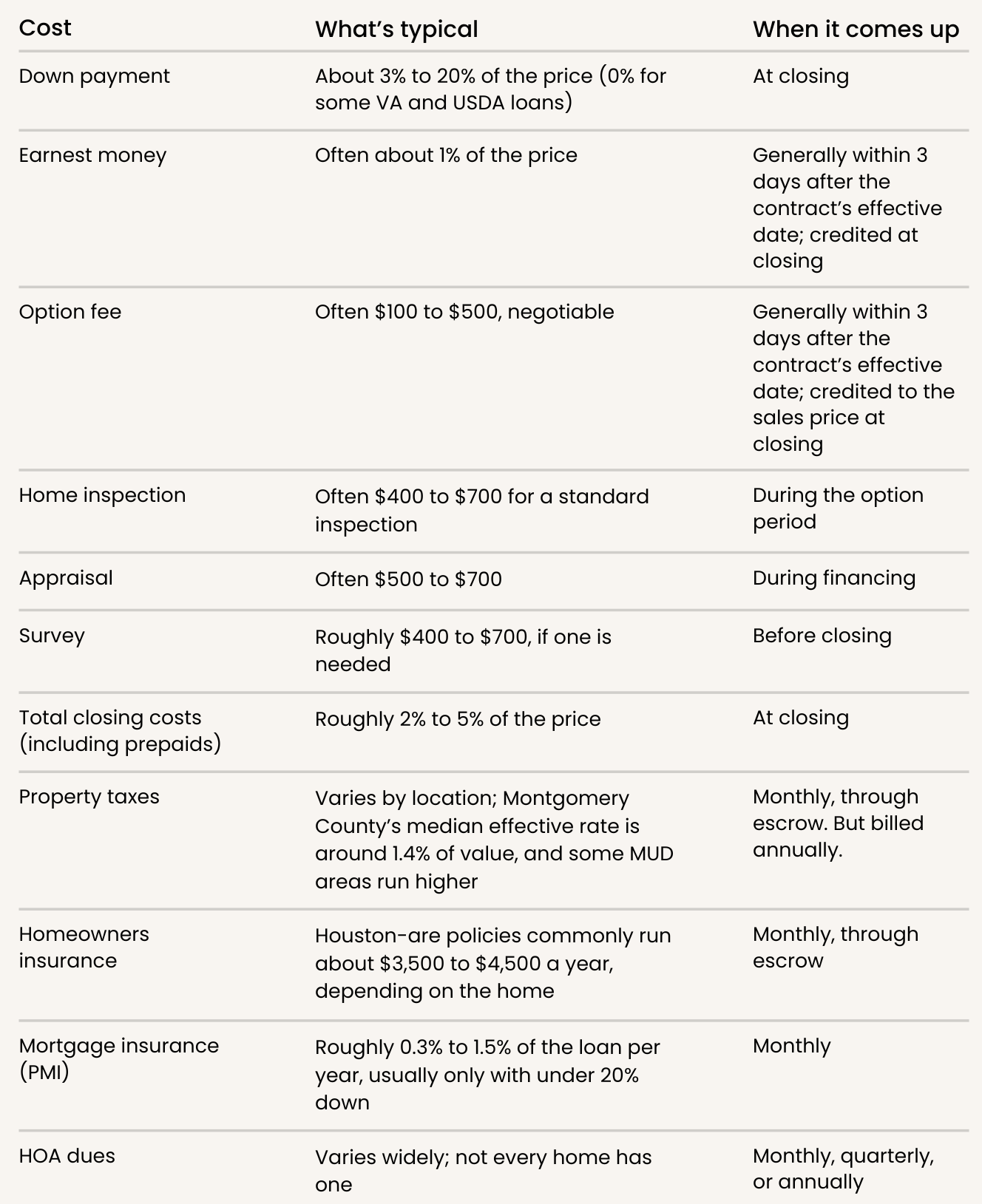
These are general ranges to help you plan, not quotes. Your lender and title company can give you real numbers.
What should you budget before you start shopping for a home in Texas?
Before you tour a single home, three things are worth knowing:
- Down payment. Typically 3% to 20% of the purchase price, depending on your loan. Conventional loans can start around 3% to 5% down, FHA loans typically start at 3.5%, and some VA and USDA loans require no down payment. Putting 20% down generally avoids mortgage insurance on a conventional loan, but it isn't required.
- Cash reserves. Lenders often like to see savings left after closing, and a cushion for first-year repairs and moving costs helps you too.
- A representation agreement. Since January 1, 2026, Texas requires license holders to sign a written agreement with a buyer before showing residential property. It must state how the agent is compensated, and compensation is negotiable. Ask how your agent is paid, and whether the seller may contribute, before you sign.
A lender pre-approval is the best early cost check. It turns "what can I afford?" into real numbers based on your credit, income, and loan type.
If you're just beginning the process, our guide to buying a home in Montgomery County, TX, can help you understand what to expect from your first home search through closing.
What costs come once you're under contract?
This is where Texas does things its own way.
Option fee. Buyers typically pay an option fee for the right to terminate the contract during an agreed option period.
Typically: $100 to $500, though the amount is negotiable. It's paid to the seller and is generally not credited back at closing.
Earnest money. A good-faith deposit held by the title company.
Typically: around 1% of the purchase price. Unlike the option fee, it's generally credited toward your purchase at closing. Not sure how these two payments differ? Read our breakdown of earnest money vs. option fees in Texas to understand what each payment covers.
Home inspection. A standard inspection looks at the home's major systems and structure.
Typically: $400 to $700 in the Houston area, depending on the home's size and age. Specialized inspections (foundation, roof, HVAC, pest, sewer line, pool) cost extra, and rural properties with wells or septic systems often need additional testing.
Appraisal. If you're financing, your lender orders an appraisal to confirm the home's value, and you generally pay for it.
Typically: $500 to $700.
Survey. Depending on the property and contract terms, a survey may be needed, and who pays is negotiable.
Typically: $400 to $700.
What do you pay at financing and closing?
Closing costs are a bundle of charges, not one fee.
Typically: buyers' total closing costs, including prepaid items, run roughly 2% to 5% of the purchase price. Sellers can agree to contribute toward them, which is worth discussing with your agent before you make an offer.
The bundle generally includes:
- Lender charges: origination, underwriting, credit report, and similar loan fees
- Title and closing charges: lender's title insurance, escrow fees, and recording fees.
- Prepaid items: your first year of homeowners insurance, plus prepaid interest
- Escrow funding: an initial deposit so your lender can pay property taxes and insurance for you when they come due.
What does a Texas buyer's monthly cost include?
Most buyers think of their monthly payment as their mortgage. It's actually up to five pieces:
- Principal and interest: repaying the loan and paying the lender. This depends on your loan amount, rate, and term.
- Property taxes: typically collected monthly through escrow. Rates vary widely by location (see below).
- Homeowners insurance: typically $3,500 to $4,500 a year in the Houston area, and often higher than in much of the country.
- Mortgage insurance (PMI or similar): typically about 0.3% to 1.5% of the loan amount per year, usually when you put down less than 20% on a conventional loan.
- HOA dues: typically $0 if the home has no HOA. Where there is one, dues vary widely by community.
Why do Texas buyer costs vary so much by location?
Property taxes. Texas has no state income tax, so local property taxes carry much of the load. There's no single statewide rate. Your bill combines rates from every taxing entity serving the property, and in many newer developments a municipal utility district (MUD). Two homes at the same price, even in the same county, can have very different tax bills. For a closer look at how tax rates, exemptions, and property values affect homeowners, read our guide to understanding property taxes in Montgomery County, TX.
Two statewide rules help buyers:
- The homestead exemption. Texas voters approved raising the general school-tax homestead exemption from $100,000 to $140,000 in November 2025. You generally need to apply with your county appraisal district once the home is your primary residence.
- Past bills aren't your bill. The seller's tax bill may reflect exemptions you won't automatically inherit, and values get reassessed. Estimate taxes for your ownership, not the previous owner's.
Insurance. Texas homeowners insurance premiums have risen sharply in recent years, largely because of storm, hail, and hurricane-related losses. Location and roof age matter a lot. Flood insurance is typically a separate policy, and whether you need it depends on the property and your lender. Get quotes early, since insurance can change what a home really costs.
What does this look like in Montgomery County?
Montgomery County shows why local details matter. Buyers here often compare suburban neighborhoods, newer master-planned communities, and rural properties in the same search, and their costs can look quite different:
- MUD and special district taxes are common in newer developments and can noticeably raise the total tax rate on an otherwise similar home.
- Rural properties may add costs like well and septic inspections that town or suburban buyers never think about.
- Insurance pricing follows Houston-area storm and weather risk, so quotes can differ by location and roof age.
- Exemptions are handled through the Montgomery Central Appraisal District.
Your real estate agent can pull the taxing entities for any specific address, which is the fastest way to replace an average with a real number.
If you're considering a move to the area, explore our Montgomery County relocation guide to learn more about the communities, neighborhoods, and lifestyle options.
Example: how the pieces fit together on a $400,000 Houston-area home
This is a hypothetical example for educational purposes only. It uses round numbers and does not represent a quote or a typical result anywhere in Texas. Your actual costs depend on your loan, credit, the property, its location, and current rates and insurance pricing.
Assumptions: $400,000 purchase price, 5% down, a 30-year fixed-rate conventional loan, and a 7% interest rate used solely for illustration, not as a current rate quote.
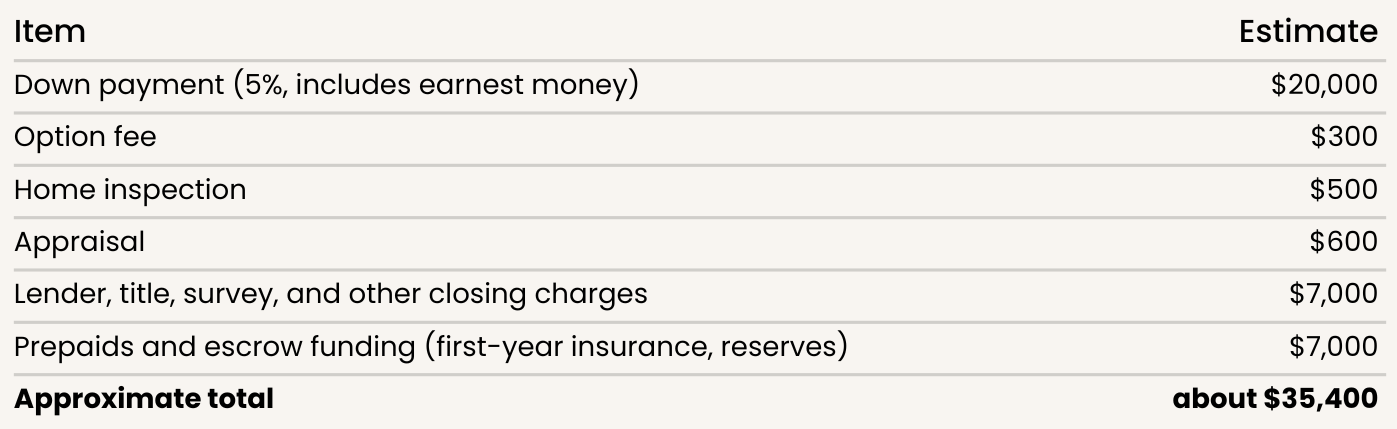
This doesn't include any agent compensation you agree to pay under your representation agreement, or repairs you choose to make after inspection. Seller contributions, if negotiated, would reduce it.
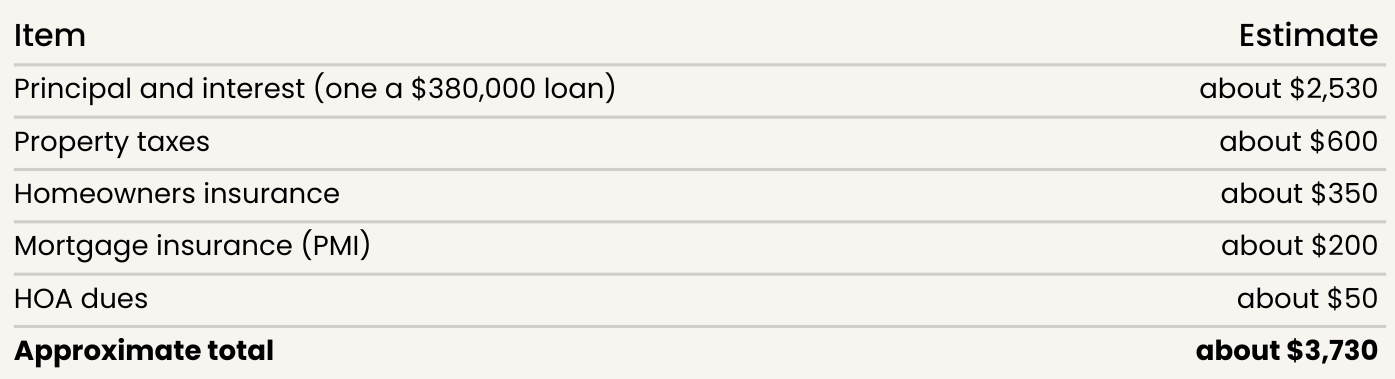
What Does This Example Tells Buyers?
The mortgage payment most buyers calculate is only part of the monthly picture. In this example, taxes, insurance, and mortgage insurance add roughly $1,200 on top of principal and interest.
The good news is that many of these pieces can change. A larger down payment could eliminate PMI, a seller contribution could reduce cash to close, and comparing insurance quotes could lower your premium. Your purchase price is not your monthly housing cost, and the best way to know your number is to run it for the specific home you're considering.
Getting a cost picture for the home you actually want
The most useful budget is one built around a specific property, loan, and location, not an average. Southern Heritage Realty helps buyers across Montgomery County, and the full greater Southeast Texas region, from suburban neighborhoods to rural properties, and we're happy to walk through what a home you're considering would realistically cost.
Ready to talk numbers? Contact Southern Heritage Realty to get started.
Selling a home before you buy? Read our breakdown of what sellers can expect to pay when selling a home in Montgomery County:
This article is for general educational purposes and isn't legal, tax, or financial advice. Consult your lender, title company, and tax professional about your situation.
Common questions about buying costs in Texas
How much cash do I need to buy a home in Texas?
Buyers typically need their down payment (about 3% to 20% of the price, depending on the loan) plus closing costs of roughly 2% to 5% of the price, inspection and appraisal fees, and some reserves. Sellers can sometimes contribute toward closing costs.
What is the difference between earnest money and an option fee in Texas?
Earnest money is a deposit, often around 1% of the price, held by the title company and typically credited toward your purchase at closing. The option fee, often $100 to $500, is paid to the seller for your right to terminate during the option period and is generally not credited back.
How much are closing costs for buyers in Texas?
They typically run roughly 2% to 5% of the purchase price, including prepaid items like your first year of homeowners insurance. Many are negotiable.
Who pays closing costs in Texas?
Buyers and sellers each pay some costs, and many are negotiable. Sellers can also agree to contribute toward a buyer's costs. Our companion guide covers the seller side: What Costs Should Sellers Expect to Pay? A Montgomery County, TX Breakdown
Are property taxes high in Texas?
Texas has no state income tax, and property taxes are a significant part of homeownership costs. Your actual rate depends on the taxing entities serving the property (school district, county, city, and any MUD) and on the exemptions you qualify for.
How much is homeowners insurance in Texas?
Premiums vary widely by location, home age, and roof condition. Houston-area homeowners commonly pay about $3,500 to $4,500 a year, and flood insurance is a separate policy.
Does my purchase price equal my monthly payment?
No. Your monthly cost includes principal, interest, taxes, insurance, and possibly mortgage insurance and HOA dues.
Do buyers have to sign an agreement with their agent in Texas?
Yes. Under a law effective January 1, 2026, a written agreement must be in place before an agent shows residential property, and it must state the agent's compensation, which is negotiable.
Check out this article next