


Downsizing in Texas works best when you start with the full picture: what your home could net after selling costs, what your next home will really cost each month, and how Texas property tax rules affect both. Most homeowners who plan 6 to 12 months ahead make clearer decisions and feel less rushed. The right timing depends more on your life than on the market, so the best first step is a conversation about your numbers and goals.
If you've been walking past the guest room nobody uses, mowing a yard that takes your whole Saturday, or wondering why you're heating and cooling 3,000 square feet for two people, you're not alone. Downsizing is one of the most common big decisions homeowners start thinking about, and the new year is when a lot of people finally get serious about it.
At Southern Heritage Realty, we help homeowners across Montgomery County and Southeast Texas make this move, and the people who are happiest afterward usually have one thing in common: they planned it instead of reacting to it. Here's what we think every Texas homeowner should consider before downsizing in 2027.
What Does "Downsizing" Actually Mean?
Downsizing simply means moving to a home that better fits your life right now, and it often means something different than people expect. For some, it's a smaller house on a smaller lot. For others, it's a single-story home, a low-maintenance patio home, a townhome, a condo, or a 55+ community. Some homeowners with acreage are "downsizing" the land but not the house, and some are trading a big suburban home for something closer to family.
The goal isn't always fewer square feet. It's usually less maintenance, lower costs, easier living, or more freedom, and often all four. Getting clear on which of those matters most to you will shape every decision that follows.

Why 2027 Is a Good Year to Start Planning
We're not going to tell you to "beat the market," because nobody times it perfectly. But there are good reasons to begin planning now:
- Your equity may be working in your favor. Many Texas homeowners have built up substantial equity through years of payments and appreciation, which can give you real flexibility on your next purchase.
- Planning removes pressure. When you start early, you can choose your timing, make repairs on your schedule, and avoid the stress of a rushed move.
- Growth shapes your options. Montgomery County has continued to grow, and that has brought new housing styles, more low-maintenance communities, and more choices than there used to be. We covered that in our recent look at why Conroe is growing so fast and what it means for buyers and sellers.
- Your next home will come with new costs. Today's interest rates, insurance costs, and HOA fees are worth understanding before you commit, not after.
Local market conditions shift throughout the year, so the most useful thing you can do is talk with a local agent who watches Montgomery County closely and can tell you what's happening in your neighborhood right now.
Step One: Know What Your Home Could Net
Before you fall in love with a floor plan, get clear on what you'd walk away with after the sale. Your net proceeds depend on your sale price, your remaining mortgage balance, and the costs of selling.
Selling costs vary by situation, but they typically land somewhere in the range of 6% to 9% of the sale price once you account for the pieces below:
- Agent compensation: negotiable and agreed upon in your listing agreement
- Title policy and closing fees: in Texas, the seller customarily pays for the owner's title policy, though this is negotiable in the contract
- Prorated property taxes: your share of taxes up to the closing date
- Repairs and concessions: items that come out of the buyer's inspection or option period
- Moving and prep costs: decluttering, cleaning, storage, and the move itself
For a deeper walkthrough, see our guide on what costs sellers should expect to pay. And if you're wondering whether to invest in updates first, our post on what to fix before listing can save you from spending money that won't come back to you.
Step Two: Understand the Texas Tax Picture
Texas homeowners have some real advantages here, and a few rules worth knowing.
No state income tax or state capital gains tax. Texas doesn't tax the profit from selling your home at the state level. Federal rules still apply, though. Many homeowners can exclude a significant portion of their gain from federal tax if they've owned and lived in the home as their main residence for at least two of the last five years, but the amounts and eligibility depend on your situation. Talk with a CPA or tax professional about your specific numbers before you list.
Your homestead exemption matters. Texas voters approved bigger exemptions in November 2025. For school district taxes, the general homestead exemption is now $140,000, and homeowners who are 65 or older (or who qualify as disabled) receive an additional $60,000 exemption. Homeowners 65 and older also have a school tax ceiling that limits how much their school taxes can rise.
Here's why that matters when downsizing: your tax situation on your next home will not automatically match your current one. If you're 65 or older, you may be able to carry over a portion of your school tax ceiling benefit to a new Texas home, but the rules are specific. Check with the Montgomery Central Appraisal District (or the appraisal district where you're moving) before you make a decision based on assumed taxes.
Property taxes vary a lot by location. Two similar homes can have very different tax bills depending on school district, city, MUD, or other taxing entity that serves them. In the Montgomery County area, MUD and special district taxes can be a meaningful part of the total, so always look at the full tax rate on a home you're considering, not just the listing price.
A smaller home isn't automatically a cheaper home to own. We've seen smaller homes in highly desirable areas carry higher tax and insurance costs than a larger home farther out.
Step Three: Decide Where You Want to Live
This is the fun part, and for Texas homeowners it's a big question, because the right "downsized" lifestyle looks different from one community to the next.
In and around Montgomery County, downsizers often look at:
- The Woodlands and Shenandoah for walkability, medical access, and low-maintenance townhomes and patio homes
- Conroe and Lake Conroe for lake-adjacent living, newer communities, and a wide range of price points
- Magnolia, Montgomery, and Willis for newer neighborhoods, a slower pace, and active-adult communities
- Spring for easy access to Houston and a mix of established neighborhoods (we wrote a full guide on what to know before moving to Spring, TX)
Across Southeast Texas, some homeowners look farther out:
- Huntsville and Walker County for a quieter, small-town feel
- Grimes and Waller counties for more space at a lower price point
- Galveston and the coast for a second-chapter lifestyle near the water, which brings its own considerations around windstorm and flood insurance
A good rule of thumb: visit at different times of day and on different days of the week. A quiet cul-de-sac on a Tuesday morning can feel very different at 5:30 on a Friday.
Step Four: Think Through the Lifestyle Questions
Numbers matter, but so does the day-to-day reality of your new home. Ask yourself:
- Will this home work for me in 10 years? Single-level living, wider doorways, and low-step entries can matter more over time than they do today.
- How close am I to doctors, family, and the things I do every week?
- How much maintenance do I actually want? A small yard, HOA-maintained landscaping, or a lock-and-leave townhome can be a huge quality-of-life upgrade.
- Do I need space for hosting? Many downsizers want to keep room for grandkids, guests, or hobbies, so "smaller" doesn't have to mean "cramped."
- What will I do with everything I own? Decluttering takes longer than almost everyone expects. Start early.
Step Five: Compare the True Monthly Cost
Here's where homeowners are sometimes surprised. Don't just compare mortgage payments. Compare the total monthly cost of owning each home:
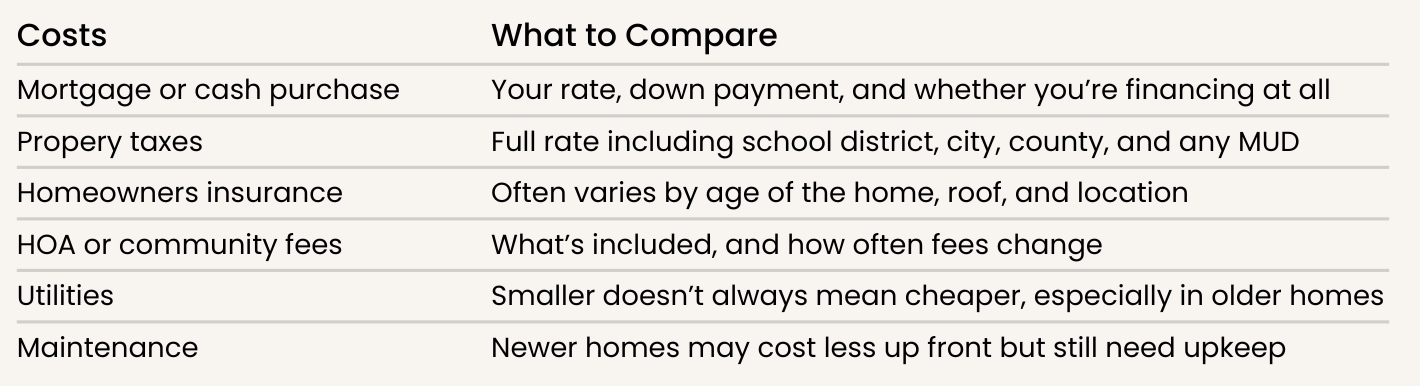
If you've had a low mortgage rate for years, it's worth running the numbers on both a financed purchase and a purchase using your equity. Neither is automatically better. It depends on your goals, and a trusted lender can help you compare.
Our post on what buyers should expect to pay breaks down the buying side, and it's worth a read even if you've bought before, since costs and rules change over time.

Special Situation: Downsizing From Acreage
If you own rural land in Montgomery, Grimes, Waller, or Walker County and you're thinking about moving to a smaller place, there's one Texas-specific issue to understand early. Many rural properties carry an agricultural or open-space valuation, which keeps property taxes much lower. If the land is sold and its use changes, such as being developed or subdivided, rollback taxes may apply, typically covering up to three years of the tax difference plus interest.
Who pays that, and when, depends on the contract and the situation. Talk with your agent and your tax professional before you list or accept an offer so there are no surprises at closing.
Sell First, Buy First, or Both at Once?
This is one of the most common questions we hear, and there's no single right answer.
- Sell first: gives you clarity on your budget and removes the risk of owning two homes, but you may need temporary housing or a flexible closing.
- Buy first: gives you more time to find the right home, but you'll need to be comfortable with the financing and the risk of overlap.
- Coordinate both: often possible with a negotiated closing date or a short post-closing occupancy for the seller, which Texas contracts can accommodate.
A strong agent will help you structure the timeline so you're not scrambling. In a market where the most desirable low-maintenance homes can draw attention quickly, having your plan in place before you shop makes a real difference.
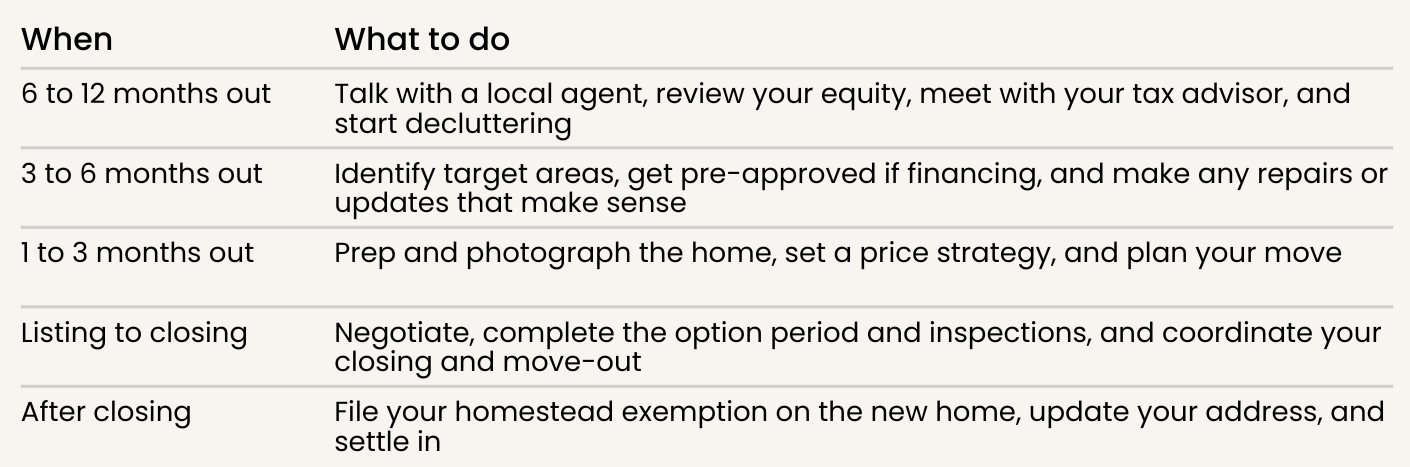
A Simple Downsizing Timeline for 2027
Every situation is different, but here's a realistic timeline most homeowners can work from:
Ready to Talk Through Your Downsizing Plan?
Downsizing is more than a transaction. It's a transition, and it deserves a plan that fits your life, not a one-size-fits-all checklist.
At Southern Heritage Realty, we serve homeowners across Montgomery County and Southeast Texas, from Huntsville to Galveston, and we're here to be your trusted, go-to resource for every step: what your home could sell for, where to go next, and how to line up the timing. Whether you're a year away or ready to start this month, we'll give you honest guidance and a clear path forward.
Contact Southern Heritage Realty today to schedule a no-pressure conversation about your 2027 plans. We'd love to help you find the right next chapter.
Frequently Asked Questions
When is the best time to downsize in Texas?
The best time is when your finances, your home's condition, and your personal plans line up. Many homeowners start planning 6 to 12 months ahead so they aren't forced to decide quickly. A local agent can tell you how your specific area is performing right now.
Do I pay taxes when I sell my house in Texas?
Texas has no state income tax or state capital gains tax. Federal capital gains rules may apply depending on your profit and how long you've lived in the home. Many homeowners can exclude a large portion of their gain, so confirm the details with a tax professional.
Does my Texas homestead exemption transfer to a new home?
The exemption itself doesn't automatically follow you. You'll need to apply for it on your new primary residence through the county appraisal district. Homeowners 65 and older may be able to carry over part of their school tax ceiling, so check with the appraisal district for the details.
Is it cheaper to own a smaller home?
Not always. Property taxes, insurance, and HOA fees can offset the savings of a smaller home, especially in sought-after areas. Compare the total monthly cost, not just the price tag.
What's the best area to downsize in Montgomery County?
It depends on what you want. The Woodlands and Shenandoah offer convenience and low-maintenance options, Conroe and Lake Conroe offer variety and lake living, and Magnolia, Montgomery, and Willis offer newer communities and a quieter pace.
Should I sell my current home before buying a new one?
Both approaches can work. Selling first gives you a firm budget, while buying first gives you more time to find the right fit. The right choice depends on your finances and how flexible your timeline is.
This article is for general informational purposes only and isn't legal, tax, or financial advice. Please consult a qualified tax professional, attorney, or lender about your specific situation.
Check out this article next